Date
Category
News
By Chris Voloschuk, Associate Editor at Recycling Today
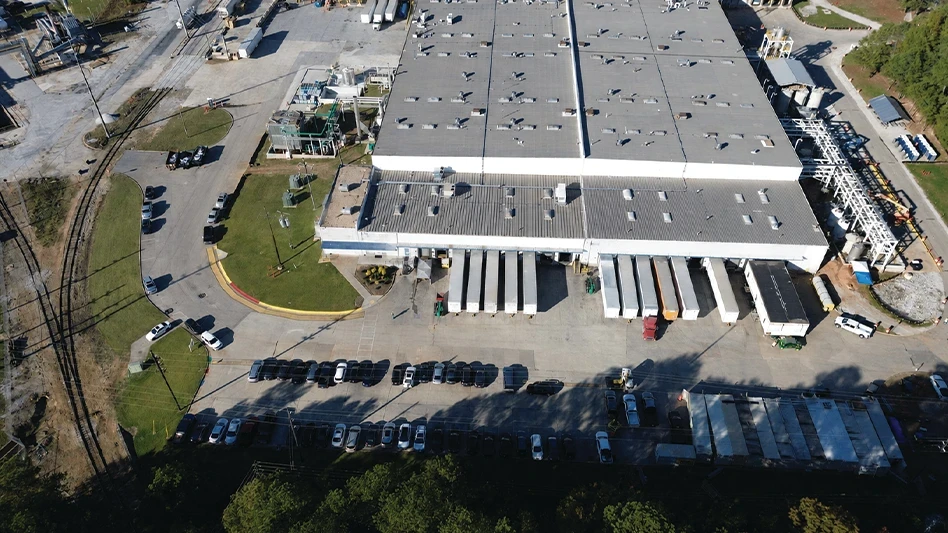
R3 Lithium Inc. recently announced the start of operations at a battery recycling facility in Covington, Georgia, that previously was owned and operated by Ascend Elements.
The 154,000-square-foot facility, which Massachusetts-based Ascend opened in 2023, was purchased out of bankruptcy by R3 Lithium in July. The commercial-scale plant is designed to produce lithium carbonate from end-of-life batteries and manufacturing scrap.
R3 Lithium, which also announced $15 million in Series A funding from investors including Integral GlobalTech Partners, TDK Ventures and Axial Partners, says it has retained the former Base 1 plant’s leadership team that first demonstrated commercial-scale recycled lithium production there in 2025. R3 Lithium says it holds approximately $1 billion in signed offtake agreements from customers such as Trafigura and is investing to bring the plant to continuous commercial operation.
The company says the new funding will be used to upgrade the existing lithium carbonate production line, which it claims was the first in United States history to produce 99 percent-purity lithium carbonate from 100 percent-recycled content at production scale. R3 Lithium says it projects that the Covington facility will account for more than 50 percent of the U.S.’ total production of lithium carbonate in 2027.
“The U.S. has spent years discussing critical mineral independence while the vast majority of lithium processing has remained overseas,” says R3 Lithium President and CEO Linh Austin, who held the same role at Ascend before it shuttered earlier this year. “R3 Lithium is here today, with a proven facility that has already produced the product, the team that made it happen and the capital needed to upgrade the line and keep it running at commercial scale. R3 Lithium is setting a new pace for domestic lithium production, starting now.”
The company will recover, refine and return lithium carbonate to the domestic battery supply chain through what it describes as a calciner-based crystallization and water-based precipitation process that extracts lithium directly from black mass on a single site without primary mining or nondomestic refining. It adds that the plant provides 30,000 metric tons of shredding capacity and a 2,500-metric-ton lithium carbonate production line, with space allocated for an additional 2,500-metric-ton line.
“Battery manufacturers, the [U.S.] Department of Energy, and OEMs [original equipment manufacturers] are increasingly seeking reliable sources of domestic lithium to support the growing U.S. battery supply chain and improve security of supply,” says Tim Wood-Dow, battery metals trader at Singapore-based commodities and logistics company Trafigura. “To date, however, domestic supply has remained relatively limited. R3 Lithium’s Covington facility helps address that gap in the physical supply chain by producing lithium carbonate from recycled feedstock on U.S. soil.”
Working toward a domestic lithium supply
According to R3 Lithium, the U.S. imports most of its lithium, with between 85-95 percent of battery cell and component production capacity currently occurring outside the U.S. and European borders. The company says federal policy, including the Inflation Reduction Act and critical mineral designations, is directing substantial resources toward closing the gap, but the timeline for primary extraction remains measured in years rather than months. It notes that new domestic lithium mines can take 7-10 years to be permitted and more than 20 years from first discovery to first production.
R3 Lithium claims it operates on a different timeline. It says the Covington facility will produce lithium carbonate from batteries already in circulation without new mining or foreign refining. The company notes that Ascend built the site with an investment of approximately $150 million and was acquired in July with no liabilities, “fundamentally resetting the economics of domestic lithium production.”
R3 Lithium says its growth plan calls for a network of lithium carbonate and black mass shredding facilities across North America and Europe, each engineered in modular 5,000 metric-ton-per-year units and deployed only with underpinning offtake agreements in place. The company says this approach enables phased capital allocation, early revenue and repeatable deployment across sites without concentrating risk in a single buildout.
Experienced leadership
R3 Lithium says its leadership team combines deep battery materials expertise with large-scale industrial operating experience. Austin brings more than 30 years of experience directing U.S. and international energy businesses, including senior roles at McDermott International, BP and ARCO.
The company’s Chief Technology Officer, Eric Gratz, is an Ascend co-founder and is the inventor of 43 patents in battery materials and lithium-ion recycling technology, as well as a member of the Technology Committee of the DOE’s Li-Bridge public-private partnership.
“Every battery already in service in this country is a lithium deposit,” Gratz says. “It is above ground, it is concentrated and nobody has to dig for it. What has been missing is the ability to get lithium back out of it at commercial scale in the United States. That is the thing we have now demonstrated—not in a laboratory and not as a pilot.”
The end of Ascend
Ascend, formerly headquartered in Westborough, Massachusetts, filed for bankruptcy on April 9 in the U.S. Bankruptcy Court for the Southern District of Texas. Along with its headquarters and Base 1 facility in Georgia, the company was in the midst of building a sprawling battery recycling campus, Apex 1, in Hopkinsville, Kentucky, and was in the early stages of building a European facility, Apex 2, in Poland.
The company was founded in 2015 and spent years scaling its patented Hydro-to-Cathode precursor synthesis process to manufacture NMC (nickel, manganese, cobalt) precursor cathode active material (pCAM) and cathode active material (CAM), recovered from end-of-life lithium-ion batteries and manufacturing scrap. It also produced lithium carbonate, nickel sulfate, cobalt sulfate and manganese sulfate from black mass.
Beginning in 2022, the company raised more than $1.1 billion from an array of investors and received grants from the DOE through the Bipartisan Infrastructure Law’s Battery Materials Processing and Battery Manufacturing Initiative.
Issues arose at the 140-acre site in Kentucky in early 2025, as Ascend faced a $138 million lawsuit from the campus’ builder, the Turner-Kokosing Joint Venture, over unpaid construction bills. At the same time, the company came to an agreement with the DOE to return a $164 million grant intended to fund CAM manufacturing infrastructure at the site, citing “changing market conditions.”
Those conditions, which included low market demand for CAM, caused Ascend to change course on its plans for the Kentucky campus, narrowing its focus to producing only pCAM and lithium carbonate. In October 2025, the DOE canceled part of the remaining $316 million of its grant award to Ascend as part of a wave of funding cuts. By that time, Ascend already had received $206 million for the Apex 1 site, but said it would use other funding sources to make up the difference.
Government settlements
On July 30, U.S. Attorney Kyle G. Bumgarner of the Western District of Kentucky announced that Ascend had agreed to pay $7.5 million to resolve civil allegations that it submitted inflated reimbursement claims to the DOE for work on the Apex 1 project in Hopkinsville.
According to a news release issued by Department of Justice, the settlement resolved the U.S.’ contention that, between Sept. 18, 2023, and Feb. 18, 2025, Ascend sought and received DOE reimbursement for goods and services that included inflated labor hours, excessive tool purchases, unnecessary equipment rentals and other “wasteful or unnecessary expenses” related to the project, and the DOE “paid more than $5.3 million tied to this conduct.”
The department wrote that Ascend voluntarily divulged the issues to the government and received credit for its cooperation, which included a timely self-disclosure, an internal investigation and assisting the government in understanding the full scope of the conduct.
“This settlement reflects the Department of Justice’s commitment to ensuring that federal funds supporting critical energy and infrastructure projects are safeguarded from misuse,” Bumgarner said. “Companies that receive taxpayer dollars must be held to the highest standards, and today’s recovery demonstrates that voluntary self-disclosure and cooperation will be met with appropriate credit while still ensuring accountability.”
Assistant U.S. Attorney Jessica R.C. Malloy handled the matter for the government, with support from the DOE. The claims resolved by the settlement are allegations only, the news release said, adding there had been no determination of liability.
As for the Apex 1 campus, the Texas bankruptcy court approved a $31.7 million bid from the Turner-Kokosing Joint Venture in early June. The campus is about 60 percent complete, according to Ascend’s bankruptcy filing, and construction remains paused. After it assumed ownership of the site in June, Turner-Kokosing and area economic development officials told local media outlets they planned to complete the project, with Turner-Kokosing potentially selling the finished campus to a buyer in the battery processing space.
Buyers in Poland
On July 13, Poland-based law firm Rymarz Zdort Maruta announced on its website it had advised Canadian investment firm Kinterra Capital on the acquisition of Ascend’s Polish assets and their related bridge financing.
In May 2025, Ascend announced that Poland’s Ministry of Economic Development and Technology had offered up to $320 million—one of the largest grants ever offered by the country—to support construction of a pCAM manufacturing facility there, dubbed Apex 2.
Ascend already had a presence in the country following a joint venture it established with Elemental Strategic Metals in 2024 to own and operate the AE Elemental JV battery recycling facility in Zawierci, Poland.
In its announcement, Rymarz Zdort Maruta says that because of the transaction conducted as part of Ascend’s Chapter 11 restructuring proceedings, Kinterra acquired Ascend’s Polish subsidiary for $100 million and is currently seeking a strategic partner to help implement the planned investment in the construction of the pCAM plant in Opole.
The law firm describes Kinterra as being focused on investments in the critical minerals sector and related infrastructure. To date, Kinterra has invested in projects in the U.S., Canada and Australia.